Feb 28, 2006

Beyond a boundary

My grad seminar ("postcolonialism') this week was on C.L.R. James's Beyond a boundary. Since none of the students wanted to present on this particular text (too much cricket and for some, not enough feminism), it was my turn as presenter. (This semester we are circulating papers in advance so people come to class prepared to ask questions: it's a new teaching technique for me but it's working well.) And so I needed to write a few pages on the James text.

Here they are:

Beyond a boundary poses certain problems for contemporary humanities scholarship. The most obvious no doubt is the familiarity with the game of cricket which it assumes of its readers. Perhaps the next most obvious concerns the question of genre: does the text belong to the lineage of criticism itself (which would mean that it is available to forms of critique that might seek to diminish it or render it obsolete) or is it, rather, to be treated as a member of a literary, or quasi-literary canon, criticism of which is always in support of the survival, if not the celebration, of its object.
This problem opens out to two others:
1. if Beyond a boundary is to be treated as part of the genealogy of contemporary academic disciplined knowledge, which discipline precisely does it connect to? Postcolonialism? (and is that in fact a discipline?) Cultural studies? Aesthetics? Sport history? It seems somewhat difficult to know what to do with it because it does not easily fall into the divisions or value-assumptions of established academic divisions of knowledge.
2. How will or ought the distance (or rather the various distances) between James and the contemporary, professional white critic touch or shape our (this ‘our’ presupposes that I’m speaking as a white professional critic) reading of him? James was a black anti-colonialist thinker, involved in revolutionary politics through most of his career. Should either his racial, ethnic identity or his revolutionary politics play a role in our relation to his writing or not? (And if we think the answer to this is ‘no’ then we have to be careful to avoid the bad faith of in fact organizing our reading of his work around his identity while denying that that this is indeed what we are doing. And if we think the answer is ‘yes’ then, at least in relation to his politics we are committed to engaging those politics, treating James as a live rather than as a canonized or archivised thinker.)
Let me leave these problems aside for now and try to clarify Beyond the boundary’s project.
James’s key move is to detach questions of cultural/racial/ethnic identity from the realm of cultural politics at the same time that relations between ‘culture’ (in this case, cricket) and politics are very tightly drawn together. More specifically: James regards cultural formations (in this case styles and practices within the history of cricket) and cultural monuments (in this case a relatively small number of outstanding cricketers) as expressions of social totalities thought of, from within the Marxian tradition, as modes of production which organize particular relations of production. But these cultural formations are not mere instruments in the reproduction of hegemonic relations of production, they form terrains which nurture pleasure, knowledge, pride, identity and resistance across communities. That certainly is the case for cricket in the British empire.
One obvious and important implication of this line of thought is that there is no hard division between colonizer and colonized cultures or even, at the level of at least certain cultural formations (cricket, literature) between colonizer and colonized interests and stakes.
The second key move is to undo the division between high and low, or popular and elite culture, not against the concept of the aesthetic but on the basis of (a reformulation of) it. Cricket for James is an art form of similar status to any other. It has a deep and long history in the transmission of ancient Greek athleticism into modern Europe and is linked to more established genres of aesthetic culture: literature and sculpture, even if its primary modern impetus is the working-class leisure enabled by industrialism and labour agitation (the 1847 Factory Act). ‘Literature’ because each game involves heroic narrative, ‘sculpture’ because cricket style contains ‘tactile values’ a la Bernard Berenson (in a line of thought about sculpture and movement and empathy that can be traced back to Lessing and Herder although James does not go there). One of the rather odd features of James’s account of this history and its connections in the mid 19th century to a particular ethos is that he praises or seems to praise Thomas Arnold, the influential Victorian educationalist, who was in fact a key disseminator of British nineteenth-century racism and colonialism, and whose educational practices, including his absorption of sport into official school life, can be seen as an instrument for British global dominance.
Yet cricket also requires modes of social organization that are open to political action. In particular, for Trinidadian cricket the question of whether black players were permitted to captain sides became a key political question, and one which helped enflame legitimate nationalist and anti-colonialist passions, which James as a journalist encouraged. James implies, although he does not explicitly declare, that the social organization of other forms of aesthetic production are also open to political intervention although clearly the more popular an art form is the more effective and important such intervention might be. This is not to say that James is interested in the politics of literary canonicity for instance, since he treats the canon not so much as a domain in which various identities should find themselves represented as a collection of consensually-agreed important works available to all (more like a cricket team than a democratically elected political body).
Let’s return to certain of the questions I began by making. Where does James fit into the methods of contemporary academic thought? It seems to me that he belongs most closely to those forms of cultural studies that emerged out the 1968 revolutions, and in particular to Communist dissident figures like Jacques Ranciere who attempt to combine a materialist analysist with a populist argument that the wide distribution of aesthetic and sensory pleasures (Ranciere calls this ‘the distribution of the sensible’) can form a grounds for a genuinely egalatarian (if not formally democratic) political practice. (It is worth noting that James did influence Cornelius Castoriadis, the social/political theorist and founder of the sixties PCF left-break-away ‘Socialism or Babarism’ group which played an important role in the 1968 May revolution and with which Lyotard, for instance, was associated.)
But James offers a particularly concrete and detailed account of the dynamic interaction between popular aesthetics and politics through his thick autobiographical relation to cricket. Beyond a boundary is only secondarily a postcolonial text: it’s true that the politics that it describes are those of anti-racism and anti-colonialism but what it is ultimately more interested in at the level of theory is a generalisable relation between sport aesthetics and community political action and will. It would not be hard to imagine a similar articulation between sport and politics concerning not race and cricket but class and football in a Raymond Williams-ish Welsh border town, for instance.
If then we are to regard James here as providing a case for a more general account of relations between politics and art then what (at the level of theory once more) are the problems he faces? The most obvious one is, I think, that he is still operating within the terms of a Luckacian model of (what Althusser called) expressive totality. That is to say, cricket expresses the totality of social relations in which it is embedded. It has no politically significant autonomy within that totality (which, if it had, would become an assemblage rather than a totality) even if it does possess aesthetic autonomy (its own specific rules, styles, skills, grace and so on). It is in these terms that, for James, the post 1929 ruin of cricket as a British and colonial ethos and, more concretely, of the styles of play pioneered by W.G. Grace is an expression of the crisis and expansion of capitalism at that time, while 1950s risk-averse cricket instantiates the welfare state. My sense is that even if this is illuminating about cricket but it is not a generalisable method of cultural analysis. (It is also worth noting that James expresses some nostalgia for the period of immediate post 1789 British radicalism in his praise of Hazlitt and of the contemporary (imaginary?) organic community which he thinks nurtured W.G. Grace and enabled Grace to bridge one epoch (pre-Victorian Britian) with another (industrial Victorian Britain).)
Perhaps the other most obvious difficulty posed by the text is its displacement of the question of difference from theory into the reading experience itself. Beyond a boundary finds and invests its own specificity in its detailed account of cricket, an account which is precisely ‘other to’ all of its readers who don’t know and love the game. Almost every page defies readers to come to terms with James’s cricket obsession as the text’s detailed descriptions of particular cricketers (Learie Constantine and W.G. Grace) and of specific games and series are used to adduce cricket’s charm. The cramming of cricket detail challenges readers not just to take the game seriously as a form of aestheticised, politicisable culture but to learn more about it. That detail ceases to pose an insuperable barrier to readers who know little or nothing about cricket to the degree that the text’s mix of autobiography, history and theory simultaneously engages their literary and intellectual interests (that is, an interest in the narrator’s account of himself and his world and an interest in conceptual questions like those I have just been outlining). These different classes of interest are not separable here—this one of the text’s triumphs. More particularly, Beyond a boundary’s very artful formal organization (in particular the order in which it sequences its sections) is, I’d suggest, designed to test a culturally distant readership’s resistance to massed cricket lore against that readership’s engagement with politics and theory as well as its seduction by the memoirs of a man who is constructing himself—not without good reason— as a cultural/national hero within anti-colonial and anti-capitalist struggle.
In terms of poscolonialism: the book offers (at least in hindsight) a rebuke to what we might call ‘vulgar postcolonialism’’s politics of identity and rejection of cultural transmissions from metropole to colony as well as (perhaps) of the thematics of subalterneity, since James’s cricket gives a vocabulary to everyone or at least to all men. (We might want to think harder about James’s treatment of gender.) However the question of whether his account from below of Trinidadian society and culture (so different from Forster and Kipling’s India and Conrad’s Costaguana) is too critical of hard localisms and the incommensurability of colonizer/colonized cultures, remains a live one.

Bibliographic note
For reasons that should by now be apparent, James has not been carefully absorbed by contemporary postcolonialism. His legacy is of more account in radical, not always academic Marxist and post-Marxist circles. Despite that and leaving aside the Tim Brennan essay in At Home in the world, I would recommend Ian Baucom’s chapter “Put a little English on it: C.L.R. James and the field of play,’ in Out of place (Princeton 1999). You might also look at Neil Lazarus’s Nationalism and cultural practice in the postcolonial world which mentions James throughout and has an excellent brief account of Beyond a boundary. Grant Farred has an essay on James’s major work his history of slave rebellion, The Black Jacobins in The politics of culture in the shadow of capital, eds Lisa Lowe and David Lloyd. Duke 1997 might also be worth looking into.

Feb 18, 2006

WW2 versus WW1

It is beginning to seem to me that WW2 had greater impact on British society and culture than WW1. In the end, fifties Britain was less like twenties or thirties Britain than twenties Britain was like 1890s Britain: at least for the population at large. This isn’t how it is usually seen, of course. Is the same true for the US, Australia and NZ??

Feb 17, 2006

Kipling's Kim

These comments come from my teaching note for a graduate seminar on Kipling's Kim that I taught yesterday. Didn't actually get to say any of this (these kind of summary and ambitious position-taking declarations aren't actually appropriate to a grad seminar), but they push in a direction I want to consider further.

For me ‘interpretation’ and close reading not the focus of professional literary studies in regard to individual texts. Nor taking philosophical or political meanings from them, nor primarily assessing them morally or politically. I'm interested, rather, in describing a text’s project from within the thickness of its historical moment, which includes the terms on which it chooses genre and form, attaches to (the history of) the literary world, and the ways it relates to a writer’s life and career. (After all, the larger interest of literature, looked at backwards, consists largely of that last.) And then, if possible, relating that project to a contemporary problematic: thus for instance, Conrad's Nostromo in relation to finance capitalism as a motor of contemporary globalization.

The vehicle for this kind of criticism is usually the paratactical essay: doesn’t involve a centralized argument necessarily.

And so more particularly to Kim
1. the novel represents a quite specific fantasy of India (a rich, magical, free, cross-cultural everyday life crammed with ‘sentimental journeys’) basically to resist liberal utilitarian modernity on one side; Schopenhaurian ‘pessimism’ on another, missionary imperialism on yet another (it’s a secular and effectively anti-Christian novel) and various forms of native anti-colonialist stuggle on the last. The space that remains for Kipling is the secular and sacrifical ‘white man’s burden’ (really the British burden with racist underpinnings) and a metaphysico-literary engagement with empire, that is to say, empire as a theme and setting for questionings about Being enabling and enabled by experiments and triumphs of literary style and form.
2. At one level, the novel's problematic is the limitations that racism entails for sympathetic imagination. At another level it is the politico-cultural predicament of the Indian settler colonial, understood and invested in from within.
3. The Orient for Kipling is both eternally deceitful and undisciplined (which is why it requires the white man’s burden) but it also provides a strengthening riposte to Western state-formation. One of the novel’s lessons is that to govern India in British terms requires law breaking, going native etc simultaneously to the utmost respect for the law and for whiteness.
4. Empire also a theatre of intelligence to which, in end, the novel belongs alongside the surveying, ethnography, and spying that it describes. It is in these terms that the ethnographer and spymaster, Creighton is closest to ‘us’ and yet almost absent from the narrative.
5. The novel is written in a particular moment in book history, namely the globalizing of the peripheries through thickly descriptive forms of journalism and short fiction mainly designed for periodicals, often to be read in new kinds of times and spaces (especially the rail trip). This involves a masculinising of the fiction reader (decline of the marriage plot). Hart Crane, Brett Hart, Mark Twain, Henry Lawson, Rolf Boldrewood, Blackwoods Magazine. Clearly Kipling is not writing ‘art-literature’ like James Joyce or Henry James, or Flaubert, or Virginia Woolf , and this allows him to amalgamate genres: Bildungsroman, imperial romance, sentimental journey, spiritual quest story, even naturalism (relation between characters and narration is ‘naturalistic’ in so far as no real possibilities for emulation by readers of characters). And certainly not written for the anti and now postcolonial ‘native’ reader, that is doesn’t imply that reader.
6. For all that Kim has a short story’s ‘gimmicky’ closure. What its famous, unresolved (or partly resolved) ending means is that Kim is finally sacrificable. He wont necessarily become an agent; he will never grow into ‘one of us’, he is too marked by his origins.
7. And yet in his capacity to lose identity, to go with the flow, he is a mimesis of a form of modern literary subjectivity. After all, his lived relation to India is the reader’s to the fiction.

Feb 13, 2006

Under the net

Taught Iris Murdoch's Under the Net in my undergraduate class on postwar British literary culture. As far as I am concerned at least, it worked surprisingly well. I was a little apprehensive since I'd never taught it (or any other Murdoch novel) before, and had no idea how her sensibility and style would strike 20 something young Americans. But they liked it. And from a teacherly point of view what's great about teaching this book is that it's not so much a novel of ideas as a novel about theory in something like the current sense. It sets into play the choice: Wittgenstein or the New Left (before that term was current of course).

As I have said elsewhere, Murdoch is the new-left intellectual who first makes the call for 'theory' to invigorate socialism in the mid-fifties but I hadn't realised that the background for that call is spelled out in her first novel. In a sense Under the net is a novel which argues for theory against spectacle (which it sees like the Situationists as colonising public life). But this only pushes the problem away a remove since Murdoch also recognises that politics are always involved in spectacle and that to enter politics requires a certain break with theory. The novel does begin to make the case for 'theoretical practice' (that is, the binding of politics to theory) but the hero doesn't abide by it. In the end what's celebrated here is literary practice: writing, living, reading literature.

The difficulty with Murdoch (of this period) is that she's a light novelist of serious intent. Like most of her contemporaries, who were formed in the depression and the war, she turns her back on modernism and the Bloomsbury cult of aestheticism, sensitivity and 'personal relationships'. Her optimism about Britain and its promise after 1945 means that she wants to connect to the population at large, which prevents her from any kind of hermeticism. But hermeticism is the lifeblood of academicisable literature, and she loses out. Certainly she does not offer the same kind of literary pleasures as does Elizabeth Bowen for instance (at her best), of a slightly different generation, and a much more traditional, Jamesian fictionalist as well as a more challenging or at least suprising one.

Then too Murdoch's own writing practices change from the late fifties taking something of a 'Shakespearean' or baroque turn (this is a topic I should explore since I really don't know her oeuvre well at all) and she becomes (regarded as) as a serious and overly established middlebrow writer, outside the currents of cultural politics or the development of novel form and style.

Feb 6, 2006

An idea: perhaps the modern concept of the aesthetic predates and forms the precondition for the modern concept of culture. Let us assume that Lessing's Laocoon is a foundational text for modern aestheticism with its argument that each sense takes its own autonomous pleasure and finds its own capacity for cognition in different and heteronomous forms of art linked to the body through that sense (sculpture, painting, poetry, music). (Winkelmann is important here too no doubt especially his then famous description of the Apollo Belvedere, dripping with gayness). Then it is clear that Lessing's argument is analagous to the culturalist argument that each society has its own not wholly comensurable meaning system in and through which it expresses itself, that is, its own culture. The key text which joins these two modes of thought might be Herder's essay on Sculpture. (And behind Lessing's move ultimately lies Locke and the Molyneaux debate?)

Another idea: literature in 18thc Britain undergoes a transformation in its social functions. The most important moments or expressions of this transformation can be taken to be: Richardson's Pamela, Sterne's Tristam Shandy and Lyrical Ballads. What 'literature' means for a figure like John Nichols or to the Gentleman's Magazine comes to an end by about 1800: literature by then is predominantly 'interesting', increasingly fictional and involved in disseminating and taking advantage of the power of sympathetic imagination and a certain democratisation both of reception and topoi (Ranciere). It would be usual to connect this transformation to the increasing exposure of literature to the market over the period but that isn't the whole story. It is also a response to the legitimation crisis involved in the separation of church from state after 1688, a separation which involves some separation of the economy from society more generally (though this is really a post-1815 development). But at any rate the new literary function is based in the new formal social state relations of the post 1745 era. The real difficulty, though, is that the old literary formation also develops during the eighteenth-century: producing new kinds of literary knowedge and new literary forms, notably the Magazine itself. It might be possible to argue, I think, that the developed form of literary knowledge and the new post-sentimental literature join in poets like Keats and Browning.

Jan 29, 2006

Have been idly reading the Penguin edition of Coleridge's Complete Poems edited by Bill Keach. It's been something of a relevation. Coleridge wrote all kinds of verse on all kinds of occasions (a translation of a 'Hebrew Dirge' as 'chaunted' at London's Great Synagogue on the day of Princess Charlotte's funeral (1817), for example, or a translation from a print on the Virgin found during his walking tour of Germany) as well as many, many short unfinished lines in his notebook. The thing is that they are all compulsively readable, even if they don’t always quite rise to poetry in the most sanctified sense of the word.
I know 'tis but a Dream, yet feel more anguish
Than if 'twere Truth. It has been often so
Must I die under it? Is no one near?
Will no one hear these stifled groans, & wake me?
Part of the interest of this is its being more a diary entry than a poem, or something in between. Its very unpoeticness (compared to say Keats) is part of its effectiveness.
Or:
As some vast tropic Tree, itself a Wood
That crests its Head with clouds, beneath the flood
Feeds its deep roots, and with the bulging flank
Of its wide Base controlls the fronting bank,
(By the slant current's pressure scoop'd away
The fronting Bank becoms a foam-piled Bay)
High in its Fork the uncouth Idol knits
His channel'd Brows: low murmurs stir by fits:
And dark below the horrid Faquir sits;
An Horror from its broad Head's branching Wreath
Broods o'er the rude Idolatry beneath.
Admittedly this is creepy not just because it’s trying to be but because it represents Coleridge’s complete failure to get the point of cultural relativism, or religious toleration but it is also fascinatingly weird (why does he need that longish description of the ‘flood’ to make his point, why is the tree on a river bank in other words?) and also, in context, Coleridege’s xenophobia seems an expression of the kind of depression and anxiety expressed in the first lines cited. It’s these kinds of connections that make the book so good.

Jan 26, 2006

Back from NZ somewhat the worse for wear. Seeing my mother becoming frailer was very depressing: her mind is pretty much what it ever was but her body is beginning to go, and dragging her capacity (and her will?) to enjoy life with it. And of course it's so hard to be close to this not just because you begin to share mum's suffering but because that suffering carries with it the message: this is likely to happen to you too.
It's nice to be back in Baltimore: I found Auckland restricted, it is stunningly beautiful and the day I spent at the Gow's sculpture park on Waiheke Island was glorious, but the place is culturally and socially so bland: the opportunities to catch complex social self-reflections and commentary in the public sphere at least (and truth to say in the private sphere too) are so rare, and everyday encounters with a range of different peoples and values barely happen, even if Maori and the new migrant communities are very present too. Maybe what I am really trying to say is that the country's imagination of itself is trapped in self-satisfaction.
But for all that I totally understand why a certain kind of American dreams of migrating there.

Jan 15, 2006

It turns out that mum is on broadband (though she hardly uses it). So here I am.
Auckland doesn't change. Or rather my Auckland doesn't change. My first response, getting off the plane about 6.30 in the morning, jet lagged but not crippinglingly, was how dazzling it is: literarily (the sunlight on the blue sea is blinding) and metaphorically.
Despite the fact that house prices have gone through the roof, that people endlessly complain about traffic jams, overpopulation, despoilation of the natural environment and so on (which may all be fair enough) it still feels raffish, incomplete, relaxed and charming to me. Yesterday I walked down to Cockle Beach about ten minutes down the hill to the north from my mother's house. There must have been about 200 Cook Islanders there, almost no Maori or Pakeha. Some wore tiaras of flowers around their head (I am sure there is a technical name for these but I dont know it); young men strummed guitars; families were collecting shell fish; old people asleep under blankets; small children everywhere and only they spoke English. It was a scene from Gauguin, even if they were clearly all from a very intact Christian denomination since there was no drink anywhere. And its that mix of the rather proper white suburbia with various alternatives (islander, maori, diasporic chinese) set into this extraordinarily benign natural setting which characterises the place.
The flipside is that Auckland is more langorous than any other city I know. The air is seeded with boredom and indifference: it possesses a thickness that keeps all intensities at bay.
Auckland in summer: dazzling langour.
In spite of that I have to work: my book proposal and a revision of my essay on Milton.

Jan 11, 2006

Am off to Auckland New Zealand for ten days or so to visit my mother, who is thinking of selling up her house and moving into some kind of retirement village. So I won't be blogging for a couple of weeks. In fact I'll be off line completely, which comes as a kind of relief.
My feelings about the trip are mixed: once baby comes I wont have a chance to spend time alone with my mother and in my old Auckland hangouts, so this visit is kind of valedictory, or feels like that. And it will be summer in Auckland, and I am looking to walking down to the Howick beaches for swims. My mother's garden will be glorious: it is large, private and on the cliffface directly fronting the Harbour. It is a pity that the child-to-come will be unlikely ever to enjoy it. On the other hand I have so much work here, and the trip itself is so uncomfortable, expecially given that now United don't fly the LAX-Auckland route I can't upgrade to business class. And I will miss being around Lisa whose pregnancy I am enjoying: it's a process of discovery.
Yesterday two emails from colleague-friends about my impending fatherhood. One from a man who has himself had a baby in a second marriage at roughly my age. Here it is: "CONGRATULATIONS!!!!! It is a fantastic gift from the gods, these creatures, early or late in one's life." And the other, from a friend who has also recently married a younger woman but whose son in his first marriage turned out to be schizophrenic (this became clear in the boy's adolescence) saying, painfully, that he couldn't face parenthood again. A very sad message, which cast a gloom over the day.
Watched the second installment of the PBS doco 'Country Boys' last night. It's about a couple of young men approaching their high-school graduation, who live in Appalachian East Kentucky, not far from where Lisa and I visited a couple of months ago. (They live near Prestonburg, we visited just north of Harlan and south of Boonesville). Mixed feelings about this: at one level, these kids and their families and society are being presented as freaks to the liberal bourgeois audience who mainly watch PBS. And the show's narrative mode: reality-TV presentation of everyday life, coupled with retrospective voice-over by the boys and some of those close to them creates weird frictions and gaps: it is clear that we are not getting the whole story—which becomes very clear, for instance, when one of the boys (Chris) is almost expelled from school for supposedly supplying a girl with speed, an incident to whose background we are given no access at all. It comes as a shock, or did to me. This means that in the end we don't actually know the boy's characters, what they are really like, for all the hours that they're on screen. Yet the program does present the material and social setting of the boys' lives with real vividness and force, and in such a way that may remind us viewers that poverty curtails opportunity at all kinds of levels, a message which has political charge, hopefully.

Jan 9, 2006

After midnight on Sunday morning, several bursts of what sounded like loud fireworks amidst laughter by a crowd of people on the street and square that our apartment overlooks. The next morning some friends who were staying over and sleeping in the front room (on the square) wondered whether what they'd heard was gunfire. I had to go out early to check the car and there was a posse of cops hanging out on the square. And then on Sunday night a heavy presence of police helicopters overhead. Welcome to inner city life: Baltimore USA. (And not only Baltimore) The friend staying over said she'd heard similar sounds in NYC some years back, assumed it was firecrackers....but it turned out to be gunfire then too. Lisa had gotten up to see what was going on and had begun to peer out of the windows to check the street out, and then figured that mightn't be such a great idea.

Jan 5, 2006

One of my tasks before teaching starts is to get through the pile of TLS's that have grown under my study coffee table over the past year or so. So as I read reviews or notions sparked by reviews that might be useful someday, I will list them here as a kind of memorandum.
1. Pierre Rosanvallon. Apparently in the school of François Furet and at one time linked to the Confédération Française Démocratique du Travail (CFDT) a left-Catholic group. Any his argument is that an effective civil society has not been established in France because all sides (Liberals, Communists and even the Right) have, since the Jacobin moment, agreed on an ideology of universalism and a strong state as its bearer which have crowded out the kind of civil society that developed in Anglophone nation-states. This has meant that the official French discourses of republicanism: democratic and egalatarian have actually been supported by an autoritarian and anti-pluralist state.
(This came home to me today: the New York Times reports that the French government (Chirac) is thinking of rescinding a quite recent decree that made it illegal to teach negative views of the French colonialist legacy!)
Anyway according to the reviewer, Sudhir Hazaareesingh (TLS Sept 24 2004), Rosanvallon's best books are Le sacred du citoyen, Le Peuple introuvable and La Démocratie inachevée as well as his new one (in 2004!) Le modèle politique français.
This is interesting to me since I am thinking about the displacements involved in the translation of 'theory' from France to Britain and the US, and this background makes some sense of the specificity of figures like Barthes, Deleuze and Foucault who just dont have the kind of framework of thick liberal civil institutions to mediate between the state and the individual in their thinking.
The difficulty is: I really don't like the kind of revisionism that Furet in particular stood for. The French Revolution needs our support: at least from afar.

Jan 4, 2006

Recently I have been thinking fairly often about Babar the Elephant. What with a child on its way and what with the 'Book People' project (more on this one day: it's the next serious project I intend to do about the history of the 'literary world'), I guess it's natural enough that my own favorite books when I was very young often come to mind. I have acquired a few early Babar editions over the years, including my favorite, a first French edition of Le voyage de Babar published by Conde Nast (under the wonderfully named 'Le Jardin des modes' imprint) in folio size in 1932. It's a marvel of style: a combination of cutting edge chic, popular visual modernism and just faintly ironic narrative aimed at children of about five I guess. The first Babar book appeared in 1931, two years after the crash and just before the World Depression really took hold but there's no trace here of anything like slump realism or leftism. Not a sliver. And what's really marvellous is the combination of text and print: the print is in some font that imitates handwriting (I remember finding it difficult to read as a kid) and is usually but not always placed at the bottom of the page in chunks of about 3 or 4 lines. But sometimes the print floats above the illustrations, offering a kind of rhythm to the reading sequence. The images themselves owe something to Matisse I think and the school of illustration he helped establish: they are strikingly pleasurable: simple, not carefully perspectivilised, not aimed at the kind of sentimental, detail-packed 'beauty' of much current art-children's-book-illustration, instead mainly relying on line, but occasionally, especially in images of night's darkness that most of the books, including this one, contain, turning to a sophisticated form of cross-hatching.
But of course from a political and maybe moral point of view there are problems. The representations of Africans belong to the conventionalism racism of the time, there's little doubt about that. And Babar himself is the kind of native colonial ruler that metropolitan colonial powers dream of: more interested in shopping for designer clothes in Paris and having fun than in independence and resistance. Is this a barrier, when it comes to reading Babar to children? To what extent, and how, does it damage the glamour and beauty of these books? I want to write about this one day, in an essay in which I will describe the rather different American and British Babars (the books were translated by different folk in each place) and the fate of the luxury children's book in general as well as the relation between reading as a child and reading as a parent to a child and, probably, after Walter Benjamin, on collecting children's books in more general terms. There's already stuff on at least some of this, a good essay by Alison Lurie published in the New York Review of Books a few years back when some kind of Babar exhibition toured the States (I think), and a book I haven't seen dedicated to praising Jean de Brunhoff, his son Laurent (who continued the franchise) and Babar too.

Jan 2, 2006

US on the way down

At the gym on the stepper the guy next to me gave a 20 minute long hate speech against the neo-cons and George W. Nothing much to disagree with there.
But it came to me that the real difficulty the US now faces is that the institutions and ideology that were developed here after the successful 1776 Revolution (which was really not a revolution but an irredentist struggle) and which basically have served it very well during two centuries and more of continually increasing power and wealth are not going to serve it so well over the next two centuries as its power and wealth decline, at least comparatively.
What worked on the way up needn't work on the way down.
It's not just that 'founding' institutions and ideology did not emphasise efficiency or community support: they emphasised 'freedom,' constitutionalism and individualism. It's that the US has never really be able to affirm the role of the state as the administrative expression of society. In times when all social resources have to managed tightly both because the market cant achieve largescale improvements in individual lives and because other nations are gaining power and influence and, presumably, because natural resources are becoming more expensive, then a wholly legitimated state becomes crucial
Yet I suspect that these are not values that help most when there's a need to confront serious limits and competition in relation to growth. This is a scary thought, since, if accepted, it would lead to a stronger state here, and while a stronger state could certainly implement more egalitarianism and more environmental sanity, for instance, it could also reduce the kind of chaos that means that America can't actually win wars like those against Vietnam and Iraq. And America, like most continental nations, does not really have much experience in building an effective and responsive strong state.

Jan 1, 2006

Back from the MLA at DC. A nice old (indeed historical) hotel, the Wardman Park Marriott. We stayed a day after the conference actually ended since the doorman here had warned us about a noisy party down on the third floor (we're on 5) this Friday (Dec 30). It turned out the party was actually on New Year's Eve (of course) and turned out to be pretty quiet....the conference itself was fine: I gave a paper and attended some (the one I got most out of was on Byron and Byronism) but most of the time was spent meeting up with Australian friends and colleagues, and with publishers. I went to the party in honour of Hillis Miller and it was good to be able to catch up briefly with him and congratulate him on his award. I was devestated to hear that Routledge had sacked Bill Germano: that kind of news is really shaking. Bill has been important to academic publishing for the past 15 years or so. And then of course Routledge forgot to bring copies of Cultural Studies: a critical introduction to their stand! God only knows what that outfit think they are doing.
It looks as though my proposal for a book on the literary world is at long last taking shape since both the publishers I talked to are interested in giving me a contract. For some weird reason I'd like a contract rather than just writing it and sending it out when done which is what most people at my stage in their careers do, I think. Having a contract in hand just gives me a sense of more security and urgency too, although I know that the contract doesnt mean a great deal, since it doesnt compel publishers to actually publish the book.
And so now the work is really piling up. And what with baby coming late April (I dont think the blog officially knows: but we are expecting a little girl circa April 24) I'm not sure how I am going to get everything done.
A to do list:
1. a short essay for a catalogue to a young Australian and New Zealand art exhibition which will tour Eastern Europe. I have a week to write this, which is being done strictly for the money.
2. a revision to my essay on Milton and visual culture which is already late for the proposed volume by Brewer and McCalman.
3. tidying up my paper on colonialism and irreligion (which I gave at the MLA) so that it at least looks like a draft for a chapter or journal essay.
4. more work on my ASECS paper on 18thc literary institutions. Part of this paper will probably have to be used for the 'belief' talk I am to give at Rutgers next year too.
5. in theory more urgent than anything: the ms etc for the 3rd ed of The Cultural Studies Reader. I havent even decided what essays to include: since Rebecca left Routledge, my heart isnt really in it, though it does make money.
6. Reworking actually what I want my book of my own essays contracted with Routledge to look like. This problem hasn't yet been solved. I now have way too many unpublished papers/essays.
7. Getting on with the big book, and, quite urgently, preparing the materials to allow my putative publishers to go to their boards for a contract. (And then I will have to decide which publisher actually to go with once that's all done.)
8. (And all this doesnt deal with various lectures I have to give this year most of which hopefully can be versions of material in place.)
And there's probably more I have forgotten about.
So you can see I am kind of petrified about all this: I have a big teaching semester coming up, we will be in Florence for Fall semester 2006 and once baby comes what will happen???

Oct 29, 2005

Another long hiatus with this blogging thing, even though I am on leave and back in Baltimore. I've got to get my act together.
Instead of blogging, I've been spending my time reading for a paper on William Beckford and another, further down the road, on something I am calling to myself the "the 18thc literary institution' and which involves reading through John Nichols 14 vol Literary Anecdotesand trying to figure out relations between the various authors and figures mentioned there. (Basically the Nichols work is a record of books that the Bowyer firm of printers printed from the end of the 17thc to the end of the 18thc.)
And then I have gotten into Library Thing, with the idea of having a list of my books available for insurance purposes (except that, as it turns out, it looks as if it will be too expensive to insure them properly). Listing your books on this site takes a long time, and is, for someone like me, addictive.
Just today too, I signed up for Fox Soccer with Comcast which means that watching the English Premier League will be taking up a fair bit of time. (Caught a great game between Tottenham and Arsenal this morning.)
I also think the whole Australian cultural studies fracas that happened just as I was leaving Canberra didnt endear me to the blogging world. (The short version: I stupidly (and no doubt reductively) criticised australian cultural studies for being too tied to the cultural industries approach and marginalising critique and theory, which sparked off really personal attacks on me, basically I think out of some weird kind of envy, a let's-fuck-over-the tall-poppy-thing). And when I got back here from Australia and New Zealand I was really busy writing an application for a Fed Fellowship. My chances for that aren't good I suspect.
Tomorrow I go for a couple of days to New Haven: to read some comments that William Beckford made in his copy of Cowper's Memoirs which is held at the Beinecke, and, more to the point, to see Nick at Wesleyan who's just got his driving licence.
Been buying tons of books. Most recently: Derlugian's Bourdieu's Secret Admirer in the Causcasus and an old book on English scholars circa 1700 for my 18thc lit institution thing.

Jun 26, 2005

Kauderstuff
Well it's nice to be back blogging, in my rather lackadaisical fashion. In fact I'm in Australia now: at the HRC in Canberra on a Fellowship. And since leaving Baltimore we (Lisa and I) were in China, first at a conference on the canons at Beijing and then holidaying in Shanghai. The China trip was amazing as usual. I'd vowed not to go back there since my previous academic trips had been so frustrating and weird, but I gave in this time partly so that Lisa who had never visited the PRC could see it. The difficulties in China are twofold: first barely anyone speaks English well enough for us to sustain a useful or at least satisfying academic conversation and then, second, the rules and conventions there are so different from those in the West, and can involve simple and obvious repression and censorship, that again real dialogue and exchange becomes impossible and, more than that, one can feel implicated in oppression, expecially when some of these events are organised by Chinese academics who are cynically and opportunistically using them for their own career advancement. This kind of response, of course, doesn't allow for the usefulness of encounters with Westerners for at least some Chinese. And this time that was more apparent. To begin with: the conference was organised by Tao Dongfeng, for whom I have a great deal of respect, and then the usual kind of events happened: we were drawn aside by Chinese participants who wanted to make sure that we were aware of the limits, injustices and censorships under which they worked. These meetings are, for me, the real point of the trip and I think this time we met and talked to people for whom our conversations mattered—I certainly learnt a lot. And there were real indications that the scene is opening up: there was a feminist protest at the conferences domination by men, which was not only absolutely justified but was also paid attention to by Tao, and then there was a real debate about the political charge of disrepectful popular culture within the repressive State, even if Tao had finally, at least formally and rhetorically, to concede. The politics of this are difficult since, Tao was arguing that youth culture, which mocks the civilisational canons, is the sign of a resistance which cant take stronger, more political forms and this argument was closed down upon by the man he called his 'boss' (that is, his mentor and teacher) on grounds that could have been simply culturally traditionalist. For him, this kind of popular culture does not deserve serious academic attention, since that in itself ratifies it. Is this a political line (in the sense of being an expression of the Party's point of view), or rather simply a kind of Chinese Arnoldianism? I dont know.
And the other thing that made this conference worthwhile was where it was. We were taken to a resort East of Beijing, beyond the city limits, owned by Capital Normal and Beijing Normal Universities jointly. It was perched above a hydro-lake, miles from the nearest shops or town. A few peasants fished the lake or looked after chickens there, that was it. The landscape had some of the classical features of Taoist landscape, if not so dramatically as the landscapes around Guilin for instance. But still: the very essence of peace.

Apr 25, 2005

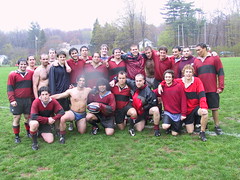
Nick's rugby team: Wesleyan April 23 2005


IMG_0034
Originally uploaded by Kauders.
Note the rain drop on the lens. Atmospheric uh? Not exactly rugby as I knew it in New Zealand circa 1960...far far more fun...
The whole blogging world seems to have been transformed since I last posted. Now the blog is in the culture; not an intriguing new thing, mainly of interest to geeks and sub-cultures and specialised political niches, but central to the communications machine, which it has transformed. We have a new form of social communication. Amazing. It's happened so quickly. What impact will it have?
For blogging itself, this involves a loss I think. As blogging moves into the centre, it becomes organized, professionalised, written for knowable readerships, taken over by the big money or those who can give it real time and energy. Amateurish pages loose their edge and interest. It's harder to strike that odd note between public and private, between the report and the diary, the trivial and the engaging that used to belong just to it and was so striking and fresh.
Me. If I am a blogger (and really I'm not), I'm old school.
Anyways.....just back from New Haven, where we went for the weekend to watch Nicholas play rugby at Wesleyan. In the pouring rain as it turned out, but fun. Not rugby as I knew it in NZ as a kid, a norm, a national obsession, but marginal, a kind of mild resistance to college liberalism.
And the New Haven I knew in 1976 has pretty much disappeared, at least down town, as I found out my last couple of times there. It's been bourgeoisified....bookshop cafes, gleaming restaurants, boutiques, the lot.
Even the Yale Centre for British Art seems to have joined the new exhibition world: not one but two shops, busy with gift-buyers. For all that its shows are wonderful: the Hodges show (the over exoticised images from Cook's voyages are less compelling than the Indian images, more sober, more tied to governmentality) and for me a more interesting one still on the British eighteenth-century landscape painter Richard Wilson. He, it turns out, combined 'historical' and topographical painting, to create a new genre which was badly received by the art establishment (mainly Reynolds) but pointed the way to the British romantic treatment of landscape in artists like Turner. What's interesting is that they display an unimaginable England; a cosmpolitan landscape that England never became.
Books bought
William Gardner Smith The Stone Face which I first read about in Kirsten Ross's imformative book on Paris 1968. Smith was an African American in Paris and the novel contains an account of the almost forgotten massacre of Algerian immigrants by the police there apparantly.
Auden's The Prolific and the Devourer, a document on his Christian-conservative turn which I hope will be instructive.
CD bought
John Zorn, Wadada Leo Smith and Susie Ibarra Live

Jan 3, 2005

Sent this email to Labyrinth Books in response to a request from them to itemise some books of the year. Why I do this, I don't know

A list of favorite books, 2004.
1. Alan Hollingworth's A Sense of Beauty. In the great tradition of the British novel of manners with oodles of sex thrown in. What I liked in particular: it's carefully and beautifully written; it doesnt rush to judgment, and with one exception (let's pass over it in silence) it doesn't peddle obvious stereotypes.
2. Philip Hensher's The Mulberry Empire. Hope this counts as a 2004 book. A historical novel mainly set in mid nineteenth-century Afghanstan, as the British scheme to take the place over. Another beautifully crafted work which isn't going to help you shore up your prejudices.
3. Christine Gerrard's Aaron Hill. A specialist's choice admittedly. But few books take one further into the emergence of modern British culture than this scholarly biography of an early eighteenth century entrepreneur, man of letters, patron, philanthropist, eccentric.
4. William St Clair's The Reading Nation in the Romantic Period. Detailed account of readerships and the book trade in Britain circa 1800. Necessary reading for anyone interested in the emergence of the British literary sensibility.
5. C;A. Bailey, The Birth of the Modern World. The latest 'global history' school comes of an age in this volume. Accessible, formidably learned, and understands that the West isnt the centre of the world, though it could go still further in this direction. For instance, the cover is dominated by a portrait of Toussaint L'Overture, but his slave-revolution, a world-historical event if there ever was one, is covered in all of two sentences.
6. Daniel Tanguay. Leo Strauss, une biographie intellectuelle. Know your enemy: a lucid account of Strauss's intellectual contribution and can be rewardingly read alongside Anne Norton's rather sensationalist Leo Strauss and the Politics of American Empire. It's a pity Tanguay doesnt historicise Strauss, but that wouldnt be a Straussian thing to do, would it?
7. Gilles Kepel The War for Muslim Minds. Kepel's probably the West's best commentator on the US's stupid war against Sunni extremists. There wasn't a book out by Tariq Ali this year, otherwise I'd probably have added that too.
8. W.H. Auden's The sea and the mirror. In these bad times I have found myself reading more poetry than usual. And strangely enough, few books of poems with more pleasure and admiration than this new edition of Auden's long and hybrid work which riffes off The Tempest.
9. Alexander Kluge, The Devil's Blind Spot. Great to have an excellent translation of a selection of Kluge's groundbreaking fictions.
10. Gérard Duménil and Dominique Lévi, Capital Resurgent. Arguably the best book of marxist economics of the past few years. It's analysis of US neo-liberalism, which prefers to think of history as continuous than as marked by breaks and transformations, is sobering.
11. Doris Sommer's Bilingual Aesthetics. This was not a good year for books in cultural and literary studies and theory, unless I missed something (which is more than possible). But I liked this book on the virtues of bilingualism a great deal, as I did the somewhat similar book: Evelyn Nien-Ming Ch'ien's Weird English.

A couple of books I haven't read but am looking forward to:
Sarah Nuttall and Achille Mbeme, Johannesburg: the elusive metropolis
Ron Padgett, Remembering Joe Brainard

Dec 21, 2004

It's been a busy time, speaking as a cultural consumer. First we watched (as a netflix dvd) the Aussie movie Praise. It's set in Brisbane, about an aimless slacker guy who gets involved with an extraordinarily energetic and demanding (most of all sexually) good time girl, Cynthia, who ends up by completely exhausting him before he manages to extricate himself. Sacha Horler who plays Cynthia gives an amazing performance of a kind of Aussie femininity which is both deeply familiar and unfamiliar: no babe, no bourgeois subject; unaffected and unselfconscious, without an ounce of introspection; she's utterly direct, into pleasure and at home with her body and appetites and yet for all that not quite at ease in the world. She's crippled most of all because she can't actually a form a relationship with the man whom she's dependent on: she doesn't have enough deliberation and reflection for that. At one level the movie's another representation of the Aussie grotesque (the grotesque is a Australian film genre all of its own whose brightest light is probably Jane Campion's Sweetie) but at another level it really does have something to say about a particular generation and class (the lower middle class who haven't gone into tertiary education) and their particular form of what would once have been called their social 'lostness' in the gap between school and 'settling down'.
And then we watched Lars von Trier's Dogville, about which more later.